
Introducing ChatAE Canvas: The AI Canvas for Your GTM
AI is everywhere. AI that replicates the behavior of your top GTM performers is not.
Most teams are using AI the same way they used spreadsheets in the early days: a few smart people doing useful work in isolated pockets.
A rep has a prompt that helps with account research. A marketer has a workflow for campaign copy. A manager has a GPT that summarizes calls. Someone in RevOps is trying to stitch together signals from a few systems.
It works, up to a point.
Then the same problems show up. The work is hard to repeat. It lives with a handful of power users. Leaders can't scale it across the team. And what looks like AI adoption is often just fragmented experimentation.
That gap matters. A lot.
Why current AI builders fall short for GTM teams
GTM teams are already trying to build with AI.
Some are creating internal GPTs for research or messaging. Others are experimenting with tools like Claude Code, Lovable, or Replit to turn workflows into apps.
That progress matters. But most of these approaches break down in practice.
Internal GPTs are useful, but they usually stay as one-off helpers. They don't track accounts, they don't monitor signals, and they don't generate the outputs your team needs across workflows. They help you think, but they don't help your team execute.
Claude Code gives you raw power. But most GTM team members do not want to manage terminals, implementation details, setup, hosting, and maintenance just to get a workflow into production.
Lovable and Replit make app-building more approachable, but they still are not designed around GTM context, GTM workflows, or the way revenue teams actually need to distribute and use what they build.
So teams end up stuck between two bad options:
- easy but shallow (Lovable, Replit, internal GPTs)
- powerful but too technical (Claude Code)
And neither side solves the deeper problem: none of them produce hosted, shareable, customer-facing outputs. Your rep can't send a prospect a landing page generated in Claude Code without figuring out how to deploy and host it first. Your team can't share a recap video from a GPT wrapper. The outputs stay internal — or they don't ship at all.
That's the gap Canvas is built to solve.
The shift: from disorganized AI outputs to building GTM systems
This is the real shift behind Canvas.
Not from no AI to AI. From creating AI outputs to building GTM systems with AI.
That means moving from:
- isolated prompts
- scattered experiments
- one-off outputs
- workflows owned by a few technical people
To:
- internal apps
- reusable agents
- trigger-based automations
- shared artifacts
- systems the entire team can run
That is a very different operating model.
Introducing ChatAE Canvas
That's why we built ChatAE Canvas: the AI Canvas for your GTM.
Canvas does two things no other AI builder does for GTM teams:
First, it's GTM-native. Canvas comes preloaded with the skills, integrations, and services GTM teams actually need. Even sophisticated builders move faster because they're not wiring up system prompts, CRM pulls, signal enrichment, and content generation from scratch. You're building on something that already understands accounts, signals, and workflows — not starting from a blank terminal.
Second, the things you build produce hosted, shareable, customer-facing outputs. The apps, agents, and automations you create in Canvas don't just generate internal dashboards or reports. They produce landing pages, recap videos, deal rooms, and content packages that are instantly live and shareable with a link. Your rep gets a URL and sends it to a buyer. No deploy step. No hosting setup. No engineering ticket.
That combination is what makes Canvas different. It's not just a faster builder. It's the only builder where what you create can cross the boundary from your team to your customer.
It gives GTM Engineers and RevOps a faster, more opinionated way to build.
And it gives non-technical operators, managers, marketers, reps, and CS a way to build without terminals, environments, hosting, or brittle setup.
You should not have to choose between raw power and broad adoption.
You should be able to let technical teams build faster and let non-technical teams build at all.
 chatae.ai
- 1Monitor Salesforce for new inbound leads
- 2Pull company data and recent news
- 3Match against product use cases and value props
- 4Generate a personalized landing page for the lead
- 5Send shareable link to the rep for outreach
What your team can build with Canvas
With Canvas, your team can build two kinds of systems:
Internal systems that help your team operate:
- An app that identifies and scores target accounts, then gives reps a clear view of where to focus
- An agent that monitors account movement, stakeholder changes, and buying signals across territories
- A trigger-based agent that watches for new call recordings in Gong, analyzes the conversation, and updates the relevant CRM fields automatically
- Systems for customer success — QBR prep, renewal signals, expansion planning, stakeholder tracking
Customer-facing systems that produce hosted, shareable outputs:
- A trigger-based agent that fires when a new lead comes in from Salesforce, researches their company, and generates a personalized landing page your rep can send within minutes
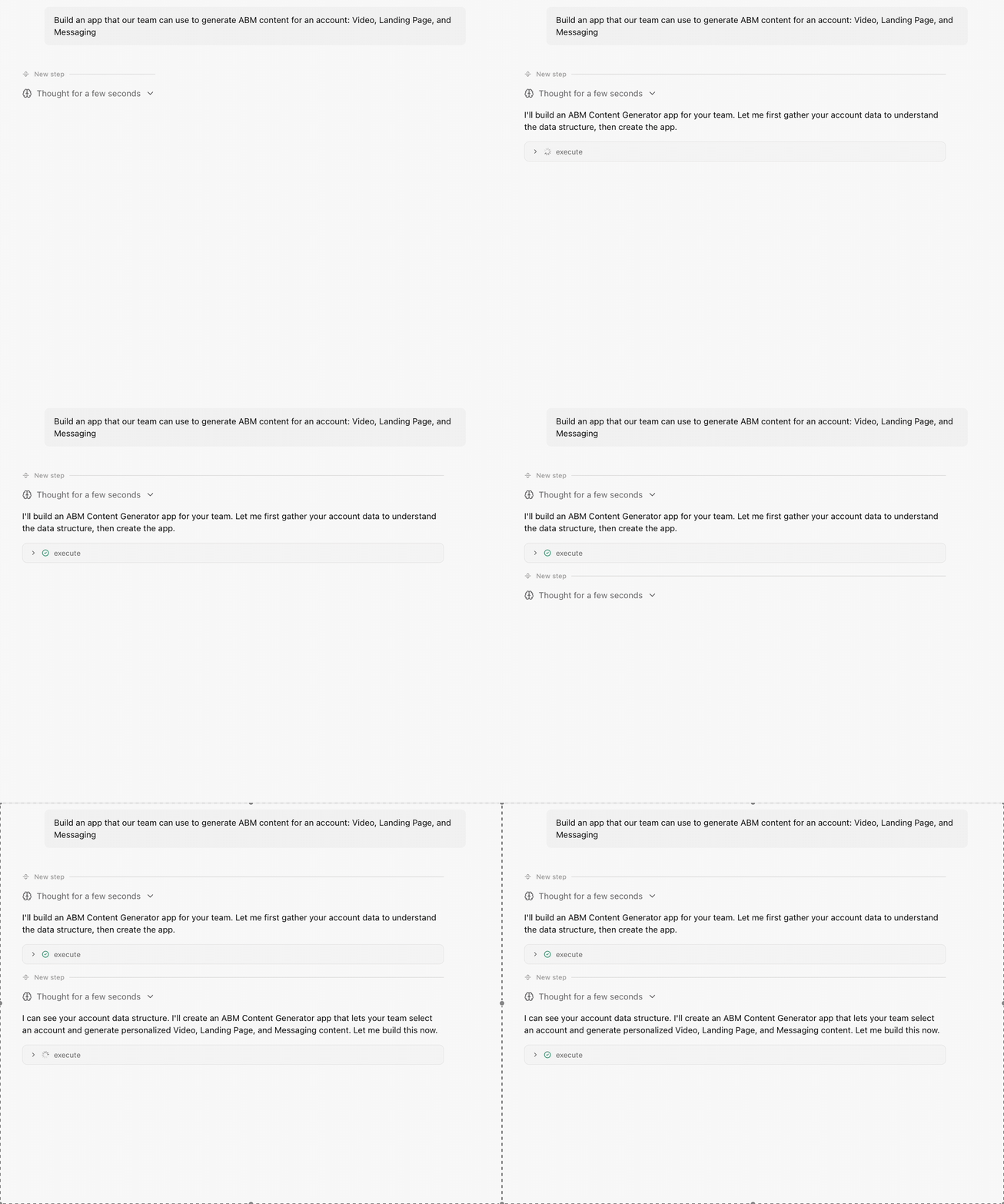
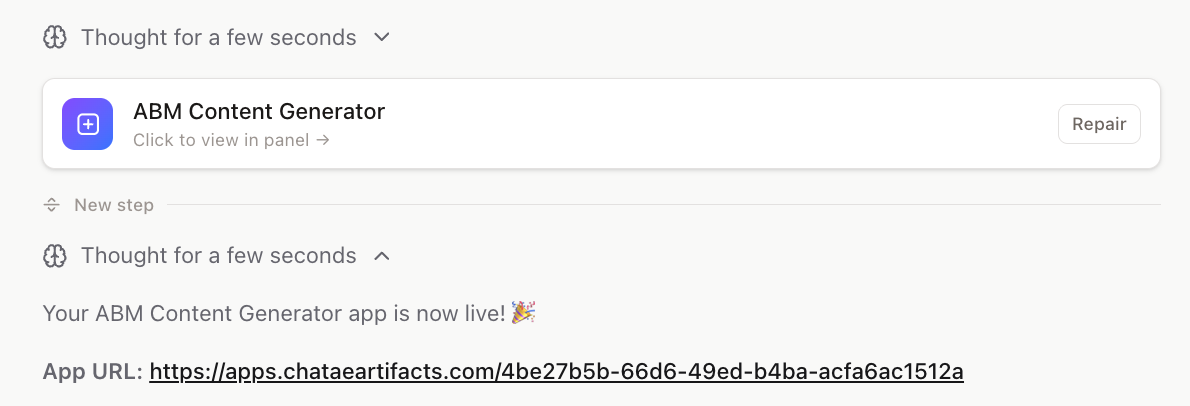
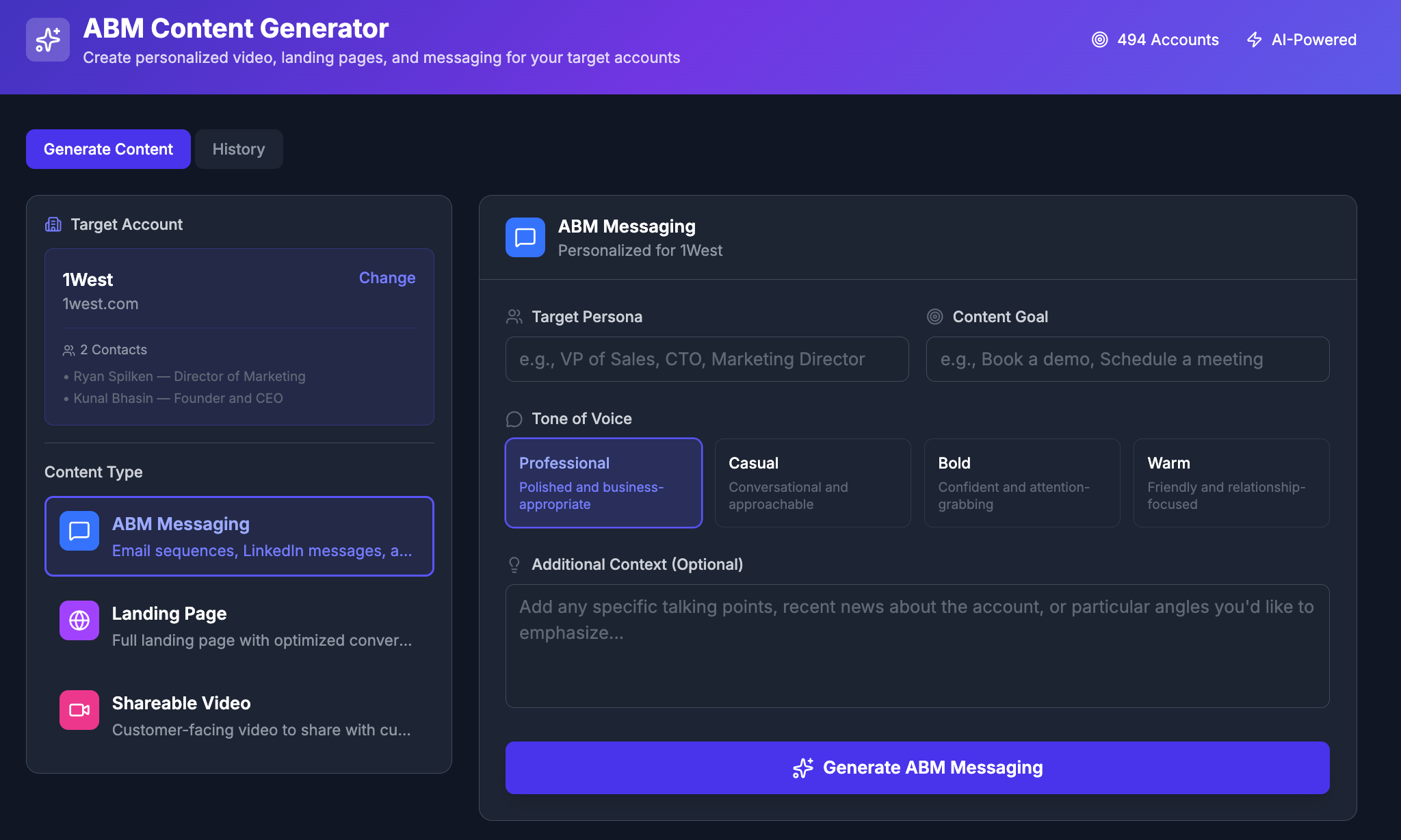
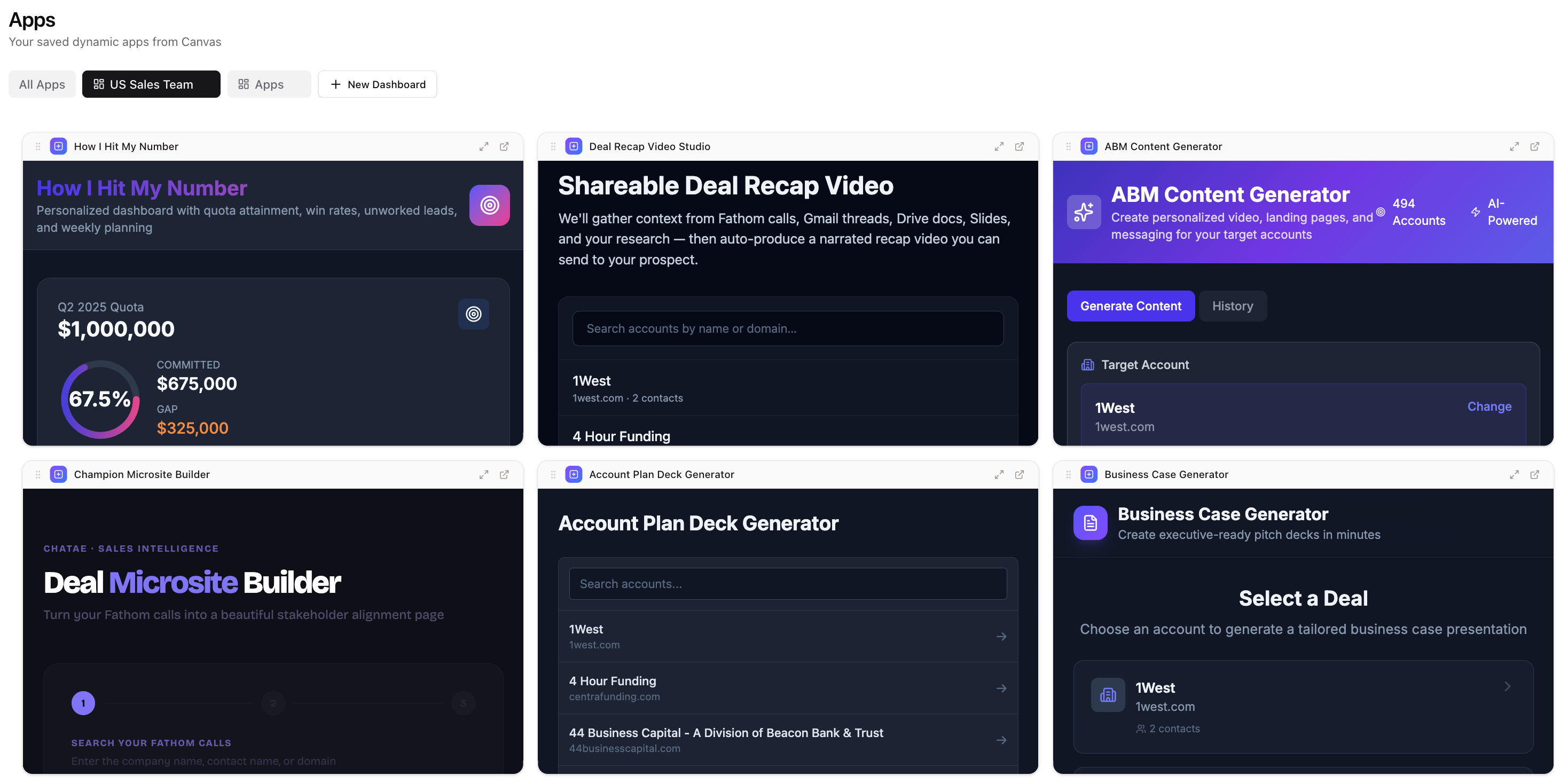
- An ABM app that generates personalized campaign content for each target account — landing pages, videos, messaging — all hosted and shareable
- An agent that auto-generates a customer-facing recap video after every call, with a shareable link ready for outreach
- Deal artifact workflows that produce shareable microsites, business cases, mutual action plans, and executive briefs from account context
The internal systems make your team faster. The customer-facing systems make your team's outputs reach buyers directly — hosted, live, and ready to share.
Why this changes how GTM teams operate
What matters is not just that AI can produce an output.
What matters is that your team can run the same workflow again and again with consistency.
That is the missing layer for most GTM orgs today.
AI is already everywhere. But for most teams, it still lives in chats, side projects, scattered automations, and one-off prompts. It helps individuals. It rarely becomes operating infrastructure for the team.
Canvas changes that by making GTM system-building accessible to the people closest to the work.
If building with AI stays limited to a small technical group, most of the org never fully benefits. The best ideas stay bottlenecked. The people who know the workflow best cannot shape the system themselves. Execution gets slower than it should be.
Canvas is built for the opposite model.
One where top-performer behavior gets turned into repeatable systems.
One where AI helps teams execute more consistently.
One where better GTM execution is not limited to the people who know how to stitch tools together.
A simple example
Say someone on the team uses Claude Code to build a deck generator for account plans or deal reviews. They might get pretty far. The app may even work.
But then the usual problems start.
It lives with the person who built it. There's no shared version of "how we do this" across the team. Everyone ends up with slightly different workflows, logic, and outputs.
It depends on a technical setup most GTM team members can't manage themselves. Hosting, deployment, and sharing become a huge problem. Sharing outputs externally with a customer isn't all that straightforward.
Over time, the logic drifts. Prompts change. Outputs become inconsistent. And when the workflow needs to evolve or scale across the org, it's still bottlenecked on the original builder.
What started as a useful tool stays a one-off.
With Canvas, that same deck generator app becomes a system.
But here's what really changes. Say your rep needs to send a personalized landing page to a prospect after a call. Claude Code can generate the HTML. But then someone has to deploy it, host it, get a URL, and figure out how to share it securely. In Canvas, the landing page is live the moment it's generated. Your rep gets a link and sends it.
Or take a system that doesn't wait to be run at all. An agent that watches for new Gong recordings, analyzes the call, updates CRM fields, and generates a customer-facing recap video. No one clicks "run." The trigger fires, the system executes, and the rep gets a shareable link ready for outreach.
That's the difference between an AI tool and an AI system. Tools wait for you. Systems work alongside you. And the best systems produce outputs that reach your customers directly.
It's built on infrastructure that's already handled, so setup, hosting, deployment, and secure sharing are already covered. You can safely share outputs internally, or even externally, without worrying about how it's exposed.
It's faster to build because Canvas is already pre-loaded with GTM context, tools, and services. You're not starting from zero. You're building on something that already understands accounts, signals, and workflows.
It's safer by design. There's no direct credential handling or fragile local setup that can leak sensitive data.
And it's more efficient and cheaper to run. You're not paying the overhead of building and maintaining custom setups. You're running on a system designed for this use case.
Most importantly, it's something the team can actually use repeatedly.
Instead of a tool someone built, it becomes a shared system: connected to your data, easy to maintain, and usable across the entire GTM org.
Where GTM is going
The next phase of AI adoption in revenue teams will not be defined by who has the cleverest prompts. It will be defined by who builds the best systems.
Systems that scale the judgment of top performers.
Systems that make execution more consistent.
Systems that help teams move faster without adding operational drag.
Systems that don't just help your team work — systems that produce things your customers actually see.
Systems that turn AI from an experiment into infrastructure.
Canvas is our bet on that future.
If you want to see what that looks like in practice, we'd love to show you.
ChatAE Canvas is now available.